

New Delhi: In a significant advancement for sustainable energy storage, a new breakthrough has emerged as researchers developed a novel cathode material that dramatically enhances the performance and stability of aqueous zinc-ion batteries for grid storage.
The innovation strengthens the potential of aqueous zinc-ion batteries for grid storage as a safe, cost-effective, and environmentally benign solution for renewable energy integration.
Aqueous zinc-ion batteries, which use water-based electrolytes, are considered promising alternatives for storing power generated from solar and wind energy.
Zinc metal offers high theoretical capacity and abundant reserves and is used directly as the anode. However, developing high-capacity and durable cathode materials has remained a major challenge limiting the broader adoption of aqueous zinc-ion batteries for grid storage.
Also Read: CSIR NIIST Tech Connect Drives Lab-to-Market Push with 11 Technology Transfers and MoU Signing
Researchers from the Centre for Nano and Soft Matter Sciences (CeNS), Bengaluru – an autonomous institution under the Department of Science and Technology (DST) – have synthesised sulfur vacancy-induced 1T-phase Molybdenum Disulfide (1T-MoS₂), offering a promising pathway to improve Aqueous Zinc-Ion Batteries for Grid Storage applications.
The research team comprising Ganesh Mahendra, Dr Rahuldeb Roy, and Dr Ashutosh Kumar Singh employed a carefully controlled hydrothermal method to produce sulphur-deficient 1T-phase MoS₂ nanoflakes.
This metallic-phase material exhibits a high surface area and enhanced electrical conductivity, enabling faster electrochemical reactions and improved charge storage performance – key factors in advancing Aqueous Zinc-Ion Batteries for Grid Storage.
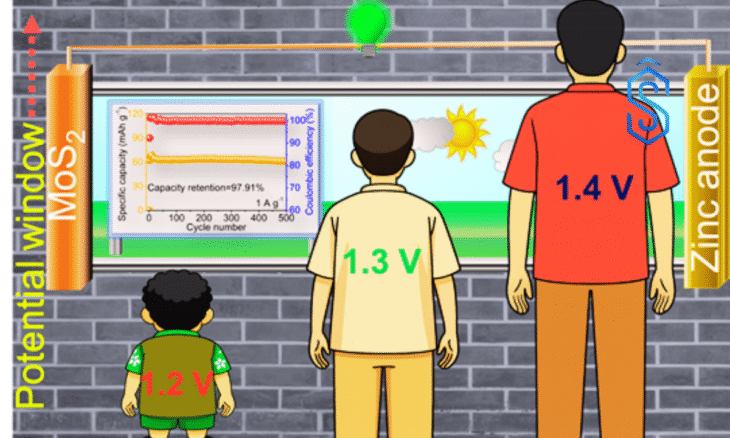
A major highlight of the study was the systematic optimisation of the electrochemical potential window, which determines the stable voltage range of battery operation.
The CeNS researchers identified 0.2 to 1.3 Volts (vs. Zn²⁺/Zn) as the ideal operational window. This precise optimisation played a crucial role in achieving superior performance metrics in Aqueous Zinc-Ion Batteries for Grid Storage systems.
The fabricated zinc-ion battery demonstrated exceptional cyclic stability, retaining 97.91% of its initial capacity after 500 continuous charge-discharge cycles at a high current density of 1 A g⁻¹.
The device also achieved a Coulombic efficiency of 99.7%, reflecting highly reversible zinc-ion insertion and extraction with minimal side reactions. Such high efficiency and durability significantly enhance the commercial viability of Aqueous Zinc-Ion Batteries for Grid Storage.
To demonstrate practical feasibility, the team used the developed material in a coin-cell prototype that successfully powered a commercial LCD timer, highlighting its real-world application potential.
Also Read: Bengaluru: CeNS Researchers Create Flexible Aluminum Battery Technology as Lithium-Ion Alternative
Aqueous Zinc-Ion Batteries for Grid Storage: Research Findings Published in Energy & Fuels Journal
This achievement further strengthens the case for scaling Aqueous Zinc-Ion Batteries for Grid Storage for renewable energy systems.
The research findings were published in the journal Energy & Fuels under American Chemical Society (ACS) Publishers.
The publication (DOI: 10.1021/acs.energyfuels.5c05072) provides a comprehensive roadmap for designing high-performance cathode materials aimed at accelerating the deployment of Aqueous Zinc-Ion Batteries for Grid Storage.
The breakthrough could pave the way for affordable, safe, and efficient battery technologies capable of storing massive amounts of renewable energy on the grid, strengthening the future of clean energy infrastructure through Aqueous Zinc-Ion Batteries for Grid Storage.